How to Choose the Best Sliding Back Door in 2026?
Choosing the best sliding back door in 2026 requires more than comparing glass sizes or frame colors. The U.S. Department of Energy reports that windows can cause 25–30% of residential heating and cooling energy loss. A large glazed door can influence comfort in the same way. Its orientation, frame material, glass coating, air leakage, and installation quality all matter. A beautiful door that creates a cold draft is not a successful upgrade.
Industry research points toward stronger replacement demand, better energy performance, and customized designs. Freedonia’s door and window market analysis identifies renovation and product efficiency as continuing market forces. ENERGY STAR guidance also encourages homeowners to compare certified performance labels, not only advertised insulation claims. Look for U-factor, solar heat gain coefficient, air leakage, and visible transmittance. Small numbers matter.
So does the sill.
Building-science expert Joe Lstiburek offers a blunt warning: “Water is a building’s worst enemy.” His point applies directly to every sliding back door. A poorly flashed sill can leave damp flooring, swollen trim, or hidden wall damage after one heavy storm. That detail is easy to miss in a showroom. I have to admit that appearance often receives too much attention. Hardware, drainage, and weather seals deserve equal scrutiny. Consider the door’s daily reality: muddy shoes, strong afternoon sun, children pulling the handle, and furniture moving through the opening. The right choice balances thermal performance, security, smooth operation, maintenance, and the surrounding wall design. There is no perfect model. There is only a better-informed fit.
What Is a Sliding Back Door and How Does It Work?
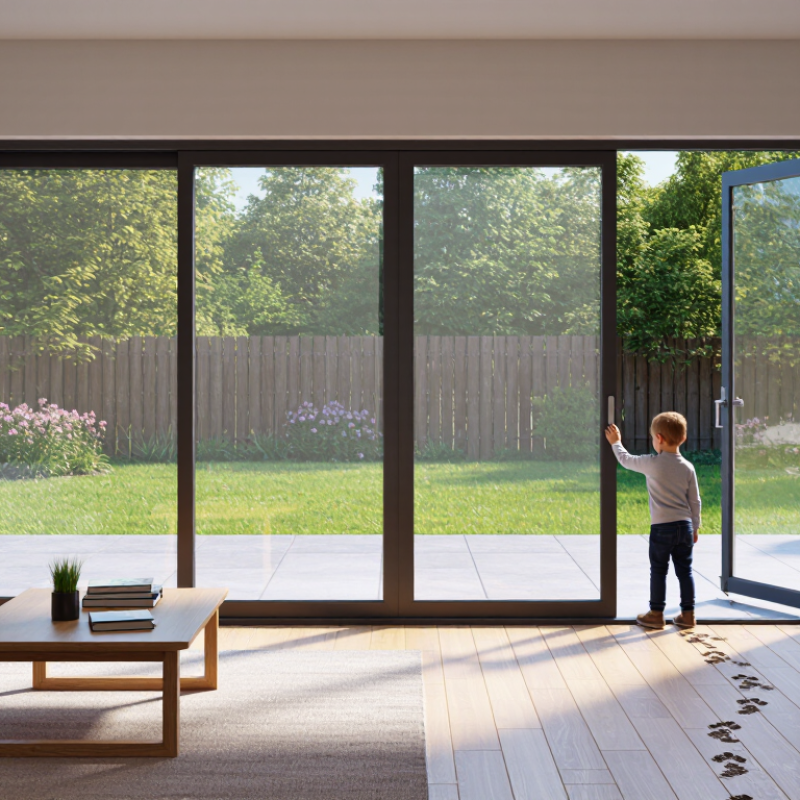
A sliding back door is a large exterior door that moves horizontally instead of swinging inward or outward. It usually contains one fixed glass panel and one movable panel. The movable panel travels along a bottom track using small roller assemblies. When you turn the handle, the lock releases, and gentle pressure moves the panel sideways. Good rollers should support the door smoothly, even when the glass is heavy.
The frame holds the panels, seals, rollers, and locking points together. Weather seals help block rain, drafts, dust, and outdoor noise. A raised threshold can improve water protection, but it may create a small trip hazard. Multi-point locks usually provide stronger resistance than a single latch. However, performance depends on correct installation. A perfectly designed door can still leak if the frame is slightly out of square. That detail is easy to underestimate.
Tips: Measure the opening at several points, not just once. Check whether the track feels firm and clean. Choose durable rollers for frequent use. Inspect the drainage holes before installation. Consider low-emissivity glass for sun-facing rooms. Ask about replacement seals and rollers, because these parts eventually wear. I would also test the handle at shoulder height and inspect the door after heavy rain. Small faults often appear later, and ignoring them can become an expensive lesson.
How to Choose the Best Sliding Back Door in 2026? - What Is a Sliding Back Door and How Does It Work?
| Door configuration | How it works | Typical opening width | Space required inside/outside | Best use | Main limitation |
|---|---|---|---|---|---|
| Two-panel sliding door | One glazed panel slides horizontally behind or in front of the fixed panel on rollers mounted in a track. | About 60–96 in (5–8 ft) | Minimal swing clearance; requires a clear wall area equal to approximately one panel width. | Patios, compact rooms, and replacement projects. | The clear opening is usually close to half of the overall frame width. |
| Three-panel sliding door | One or two panels move along parallel tracks, allowing a larger portion of the frame to open. | About 96–144 in (8–12 ft) | Needs a larger adjacent wall zone for the moving panels; no door-swing arc. | Wide patios and living rooms where daylight and access are priorities. | Heavier panels can require more precise installation and track adjustment. |
| Multi-panel sliding door | Several panels slide on one or more tracks; some designs stack the panels behind one another. | About 144–240+ in (12–20+ ft) | Requires substantial wall or stacking space, depending on the selected track layout. | Large openings, entertaining areas, and strong indoor–outdoor connections. | Higher structural, installation, drainage, and hardware requirements. |
| Lift-and-slide door | Turning the handle raises the panel slightly off the seals, reducing roller friction; the panel then slides and reseals when closed. | About 72–240+ in (6–20+ ft), depending on the system. | Minimal swing clearance; needs a properly supported sill and accurately leveled track. | Large glazed panels where smooth operation and tighter weather sealing matter. | Usually costs more and demands careful structural and installation planning. |
| Pocket sliding door | The panel slides into a concealed cavity inside the wall rather than remaining visible beside the opening. | About 24–72 in (2–6 ft) per panel | Requires a wall cavity wide and deep enough to house the door panel and operating hardware. | Space-saving designs and unobstructed wall layouts. | Retrofitting can be difficult because plumbing, wiring, and structural supports may occupy the cavity. |
Material, Glass, and Performance Comparison
| Selection factor | Practical options | Useful characteristics | What to verify before purchase |
|---|---|---|---|
| Frame material | Vinyl, aluminum, wood, or fiberglass/composite. | Vinyl generally needs little painting; thermally improved aluminum offers slim sightlines; wood provides a traditional appearance; fiberglass/composite offers dimensional stability. | Climate exposure, drainage design, finish maintenance, thermal breaks, and structural load limits. |
| Glass configuration | Double glazing, triple glazing, laminated glass, low-emissivity coating, or solar-control coating. | Insulating glass reduces heat transfer; laminated glass improves impact resistance and can remain bonded after breakage; coatings can reduce solar heat gain. | U-factor, solar heat gain coefficient, visible transmittance, safety-glazing compliance, and condensation risk. |
| Thermal performance | Look for tested U-factor and air-leakage results rather than glass type alone. | Lower U-factor means less heat transfer through the complete door assembly; weatherstripping and interlocks also affect comfort. | Whole-unit performance, certified test data, local energy requirements, and correct installation details. |
| Security | Multi-point locks, anti-lift blocks, reinforced keepers, laminated glass, and externally inaccessible rollers. | Security depends on the complete assembly, including the frame, lock points, glass, track, and surrounding wall. | Independent forced-entry testing, lock engagement, fixed-panel retention, and compatibility with the wall structure. |
| Threshold and drainage | Standard raised sill, low-profile sill, or accessible threshold with integrated drainage. | Raised thresholds generally provide more room for water management; low thresholds improve accessibility but need careful weatherproofing. | Step height, slope, sill pan, weep paths, flashing, local rainfall, and flood-zone requirements. |
| Operation and maintenance | Adjustable rollers, stainless or corrosion-resistant hardware, removable track covers, and replaceable seals. | Clean tracks, clear drainage openings, inspect seals, and adjust rollers when the panel becomes difficult to move. | Replacement-part availability, cleaning access, hardware warranty, and recommended maintenance intervals. |
Note: Opening-width ranges are common planning ranges, not universal limits. Actual sizes, thermal values, water resistance, air leakage, and structural ratings vary by door design, glazing, local building codes, and installation quality.
Related Posts
-
10 Best Sliding Door Manufacturers Worldwide?
-
The Ultimate Guide to Choosing the Perfect Sliding Back Door for Your Home
-
2026 Best Aluminium Patio Doors for Your Home Needs?
-
Essential Guide to Sliding Patio Door Installation: Tips and Steps for Success
-
How to Choose the Best New Patio Doors for Your Home
-
What Are the Best China Patio Doors for Canada?