7 Outdoor Floor Buying Tips for Global Buyers
Choosing an Outdoor Floor for an international project takes more than matching a sample to a patio. Buyers must weigh climate, foot traffic, installation needs, maintenance, and shipping conditions. A sunlit coastal terrace, for example, faces different challenges from a shaded courtyard with frequent rain. Small details matter. Surface texture affects grip. Color can influence heat absorption. A thick, attractive sample may also require specialized cutting tools or a stronger supporting base.
“An outdoor surface should be judged where it will live, not only under showroom lights,” says Maya Chen, an outdoor flooring consultant. Her advice captures a practical point: request technical specifications and compare them with the actual project conditions. Check slip-resistance data, water absorption, dimensional stability, and cleaning guidance. Ask suppliers for full-size samples when possible, then inspect them in natural light. Confirm product dimensions, packaging, lead times, and replacement availability before ordering. Details travel.
Global buyers should also consider how the product will perform after installation. Will furniture legs scratch the surface? Can local crews follow the recommended preparation steps? Does the finish show dust or water marks easily? These questions are not glamorous. They can prevent costly surprises. No product suits every site, and marketing claims deserve careful checking against published test data and written warranty terms. The seven tips in this guide help buyers compare options with clearer criteria, ask suppliers better questions, and choose an Outdoor Floor suited to the project—not just the photograph.
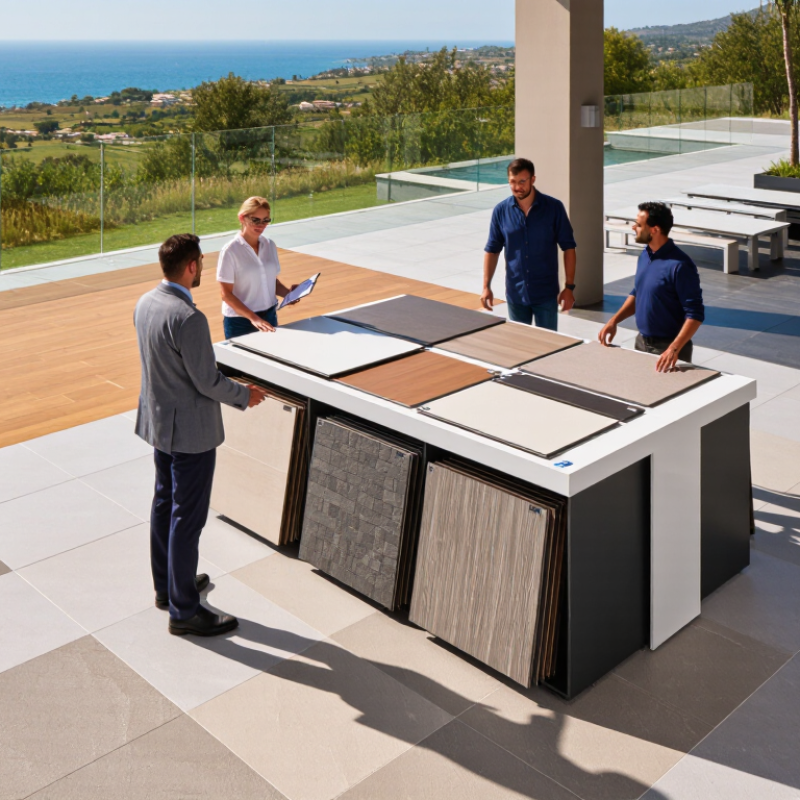
Define Project Needs and Outdoor Usage Conditions
Before comparing outdoor flooring, define where it will be installed and how people will use it. A poolside terrace needs dependable wet-foot traction; a restaurant patio may face chair movement, food spills, and frequent cleaning. Record the expected foot traffic, drainage direction, shade, and maintenance schedule. Measure the site, too. A small slope can send rainwater toward a doorway, where it becomes a practical problem.
Climate matters as much as appearance. The U.S. Environmental Protection Agency reports that urban areas can be 1–7°F warmer than nearby rural areas during the day. Dark paving may feel especially hot in exposed areas. Check local temperature ranges, rainfall, freeze-thaw exposure, and sun hours before choosing a surface. Ask suppliers for relevant test results, such as water absorption, slip resistance, and dimensional stability. Results depend on test methods and installation; they are not guarantees for every site. I have seen good specifications fail when drainage was overlooked. That is worth checking twice.
Tips: Sketch the project zones and note wet, shaded, sunny, and high-traffic areas. Share those details with suppliers, and request samples to assess texture and heat under local conditions. If you cannot test the surface in real weather, say so—and leave room for uncertainty.

Compare Outdoor Flooring Materials and Performance Features
When comparing outdoor flooring, start with water, heat, and slip exposure—not appearance alone. The Tile Council of North America’s ANSI A137.1 specification classifies porcelain tile as having water absorption of 0.5% or less. That low absorption helps in wet, freeze-prone settings, but it does not make every tile safe underfoot. Check the product’s wet-slip test results and installation guidance. A shaded patio can stay damp longer than a sunny one.
Wood and wood-plastic composite feel warmer underfoot, yet they respond differently to weather. The U.S. Forest Products Laboratory’s Wood Handbook explains that wood expands and shrinks as moisture content changes. Leave suitable gaps, and inspect fasteners and coatings over time. Composite boards may reduce routine staining and sealing, but surface temperature and scratch resistance vary by formulation. Test a sample in direct sun. Small differences matter.
For stone, concrete pavers, and deck boards, compare stated load capacity, drainage needs, and maintenance intervals. The National Concrete Masonry Association’s segmental-pavement guidance emphasizes a stable, well-drained base; poor drainage can undermine even durable pavers. Ask suppliers for test methods, not just performance claims. Reports do not always reflect your climate or installation quality. That limitation deserves attention.
Evaluate Climate Resistance, Safety, and Maintenance Requirements
Outdoor flooring should match the weather it will face, not just the showroom sample. In hot regions, dark surfaces can become uncomfortable under bare feet. In wet or freeze-thaw climates, ask for documented water absorption and temperature-resistance data. Check whether the product needs expansion gaps, since heat can make some materials shift. A small sample left outdoors for several days may reveal fading or surface changes, though it cannot replace technical testing.
Safety depends on more than a textured appearance. Request slip-resistance results for both dry and wet conditions, especially around pools, steps, and shaded areas where algae may grow. Look closely at edges and transitions; a raised corner can catch a sandal or collect water. Drainage matters. Watch the site after rain. If puddles remain, the sub-base or slope may need attention before installation.
Maintenance requirements can vary with dust, salt air, leaves, and frequent cleaning. Ask which detergents and tools are suitable, and whether sealing or periodic coating is required. Test a cleaning method on a spare piece first. It is easy to underestimate upkeep when choosing from a clean sample. A lighter surface may show stains sooner, while rough textures can hold debris. Balance appearance with the time available for care.
Check Installation Methods, Dimensions, and Supplier Standards
Before comparing colors, confirm how each outdoor floor is installed. Interlocking tiles need a firm, reasonably level base, while loose-laid decking may require drainage beneath it. Ask whether the product needs clips, edge trims, or expansion gaps. A sample installed on your actual surface can reveal rocking, awkward cuts, or water pooling. Small test, useful lesson.
Check dimensions in both product and package listings. A stated panel size may exclude connector tabs, and nominal thickness can differ from the finished height. Measure the doorway, steps, and drain covers, then calculate coverage with a small allowance for cuts. For a 4-by-5-meter patio, sketch the layout before ordering; this helps avoid narrow strips along the edges. I once underestimated a drain opening, and trimming around it took longer than expected.
Supplier standards deserve the same attention as product appearance. Request written specifications for material, thickness, load guidance, surface texture, and outdoor exposure. Ask how batches are checked and whether installation instructions match the exact item being quoted. Clear answers are a good sign; vague claims are not. Confirm packing details, replacement-part availability, and what evidence is needed for a quality concern. Specifications can still leave room for interpretation, so keep the agreed measurements and installation notes in writing.
Calculate Total Costs and Verify Global Shipping Options
A low price per square metre can be misleading. Before ordering outdoor flooring, calculate the full landed cost: product, packaging, inland transport, ocean or air freight, insurance, and destination charges. Ask whether the quote includes customs duties, taxes, and terminal handling; these may be billed separately. Small print matters.
Measure the usable area, then add a reasonable allowance for cuts and damaged pieces. For example, a narrow patio with angled edges may create more offcuts than a simple rectangle. Request the carton dimensions, gross weight, and pallet count. These details help a freight provider estimate transport accurately and reveal whether delivery access could be a problem. A truck may not reach a tight residential street.
Verify shipping options in writing before paying. Confirm the departure port, estimated transit time, tracking availability, and whether delivery is port-to-port or door-to-door. Ask who arranges unloading and what happens if the shipment is delayed or cartons arrive damaged. Keep photos and inspection notes. Not every supplier can control port delays, and a promised arrival date is rarely a guarantee. I have seen buyers overlook storage fees while waiting for local clearance; it is an easy detail to miss. Compare at least two freight quotes using the same shipment details, then keep a buffer for exchange-rate changes and unexpected charges. Don’t guess.
7 Outdoor Floor Buying Tips for Global Buyers: Calculate Total Costs
Illustrative landed-cost breakdown for an international flooring order
This planning example allocates the order total across product, packaging, inland transport, international freight, insurance, customs duties, and destination handling. Actual costs vary by product, route, shipment size, and import rules. Request a detailed quotation and verify shipping terms and destination charges before ordering.

